
Beach Elopement Guide: Elope by the Ocean


4,647 words
~21 min
Comprehensive

What Is a Beach Elopement and Why It Works
A beach elopement is not a wedding that ran out of budget. Let me be direct about that from the start, because the misconception costs couples months of second-guessing. A beach elopement is a deliberate, legally binding ceremony conducted on or adjacent to a shoreline — typically with two witnesses, an officiant, and no audience beyond the horizon. No seating charts. No catering minimums. No venue coordinator who's also managing four other events that weekend.
The format works because it strips the ceremony back to its actual function: two people making a legal commitment in a place that means something to them. What it requires — and this is where most DIY couples hit a wall — is precise logistical preparation. The beach doesn't care about your timeline. Tides don't negotiate. Wind doesn't read your mood board.
I've watched couples arrive at a "perfect" beach in Florida at 14:00 in July, directly into 34°C heat, a south-southwest onshore wind that destroyed every floral arrangement within eight minutes, and a crowd of day-trippers who had no idea a ceremony was happening. That's not an elopement. That's a public event with paperwork.
The beach elopement format works best when the location is chosen for logistical reasons first — wind exposure, tidal access, legal permit status, golden-hour angle — and aesthetic reasons second. The aesthetics will follow if you've done the groundwork.
Intimate Beach Wedding vs Traditional Wedding
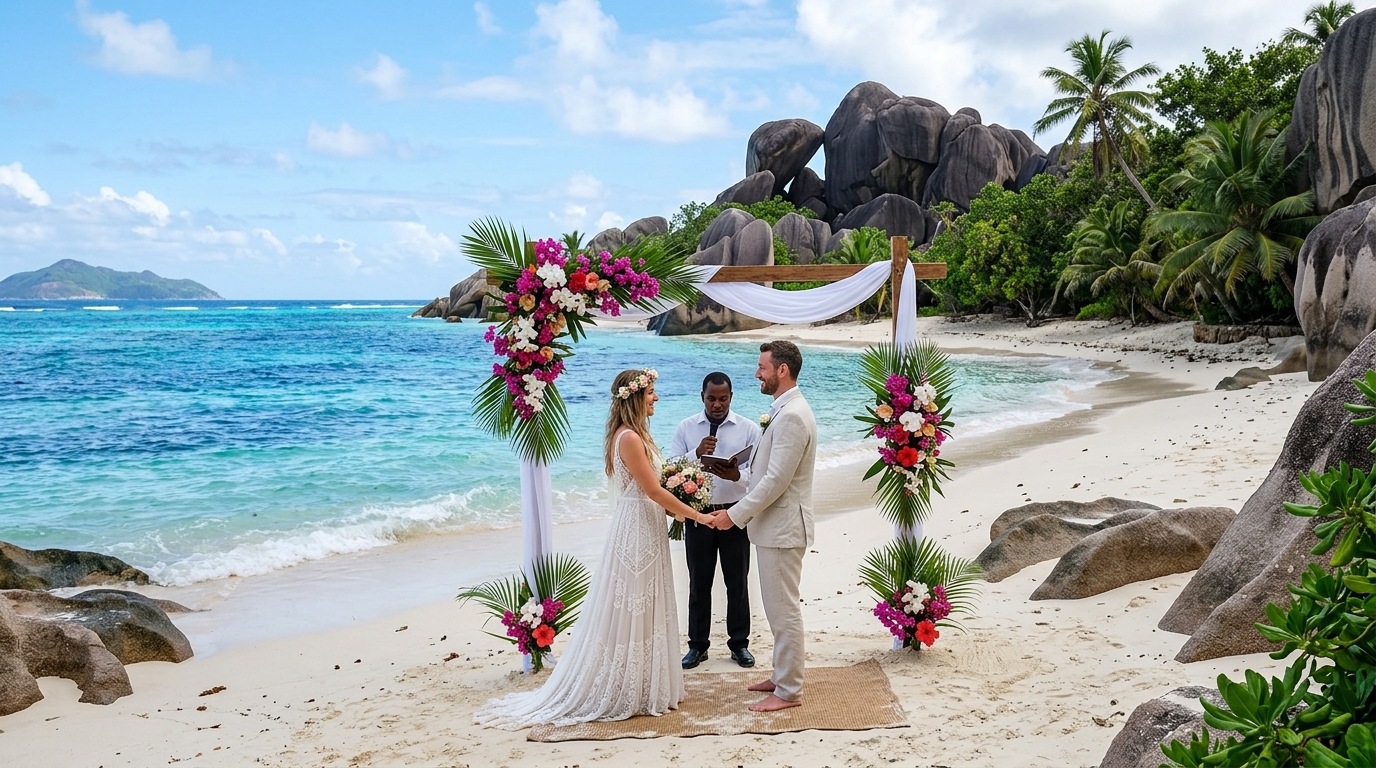
The traditional wedding industry is built on scale. Venues price per head. Caterers have minimums. Florists charge setup fees that assume a certain square footage of decoration. An intimate beach wedding — even a destination beach elopement — inverts every one of those assumptions. You're paying for access, expertise, and execution, not square footage or guest count.
The practical difference matters more than the philosophical one. A traditional wedding in the US averages somewhere north of $30,000 — and that's before you've added a photographer who actually knows what they're doing, or a venue that doesn't double-book. An intimate beach wedding in the Seychelles through a managed service like Weddingsey can land between $3,000 and $8,000 all-inclusive, depending on island, date, and add-ons. That's not a budget option. That's a reallocation of what you're spending money on.
But the real difference is control. At a traditional wedding, you're one of many events the venue is running that month. At a private beach ceremony on La Digue or Praslin, you are the only event. Full stop.
Why Seychelles Redefines the Beach Elopement Standard
I've worked in the Maldives, Mauritius, and along the Croatian coast. Each has its strengths. But for a destination beach elopement, the Seychelles has a structural advantage that none of the others can match: the beaches are legally public, the civil marriage process is genuinely fast, and the scenery is — without resorting to overused adjectives — geologically unique. Nowhere else on earth do you get 650-million-year-old granite formations meeting cobalt Indian Ocean water on a beach you can legally access without a resort booking.
Anse Source d'Argent on La Digue is the most-photographed beach in the Indian Ocean for a reason. The granite boulders create natural ceremony backdrops that no florist can replicate and no set designer could budget for. The light at 17:30 during the inter-monsoon period hits those boulders at an angle that makes every photograph look like it was shot on a medium-format camera with a full lighting crew. It wasn't. It's just the geography.
And the legal framework — which I'll cover in detail later — is among the most foreigner-friendly in the region. That matters enormously for a beach elopement package that needs to deliver an actual marriage certificate, not just a symbolic ceremony.
Best Beach Elopement Locations vs Seychelles
Every travel publication runs a "best beach elopement locations" list. Most of them are written by people who have never had to pull a permit, manage a vendor in a remote location, or explain to a couple why their ceremony flowers arrived wilted because the inter-island ferry ran two hours late. I have done all three. So let me give you a comparison that's actually useful.
The most-cited domestic US options are Florida's Emerald Coast, California's Malibu and El Matador Beach, Cannon Beach in Oregon, and Fort Lauderdale. All of them are accessible. Most of them require permits. Several of them are genuinely beautiful. None of them offer the combination of legal simplicity, photographic uniqueness, and genuine privacy that the Seychelles delivers — particularly for a couple who wants their elopement on the beach to feel like it happened somewhere specific, not somewhere generic.
The honest comparison isn't about which beach is "prettier." It's about what the full experience delivers: the ceremony, the photographs, the legal outcome, and the memory. On that matrix, the Seychelles wins on every axis except flight distance.
Florida, California, and Carolinas: Pros and Cons
Florida's Emerald Coast — particularly around Destin and Fort Walton Beach — has white sand and warm water, and the permit process through county parks departments is manageable. Expect to pay $50–$250 for a ceremony permit, file 2–4 weeks in advance, and comply with time restrictions that typically prohibit ceremonies during peak beach hours. Fort Lauderdale's beach permit system is slightly more bureaucratic and requires a separate vendor permit if you're bringing a photographer who charges for their services. I've seen couples spend more time navigating the Fort Lauderdale parks department than they spent on their actual vows.
California's Malibu is genuinely beautiful — El Matador Beach in particular has sea stacks and coves that photograph well. But El Matador requires a 0.3-mile descent on a steep trail with no accessibility accommodation, has no restroom facilities at beach level, and the parking lot holds 15 cars. On a Saturday in June, you will share that beach with 60 other people regardless of what time you arrive. Cannon Beach in Oregon is more atmospheric — the Haystack Rock formation is genuinely dramatic — but the Pacific Northwest climate means you're gambling on weather from October through May, and even June offers no guarantees.
None of these are bad options. But none of them are private, and none of them are logistically simple once you add a photographer, an officiant, and any kind of styling.
Seychelles Beaches: Anse Source d'Argent vs Malibu
Anse Source d'Argent is more private than Malibu's El Matador Beach — but not because it's unknown. It's because La Digue's total population is around 3,000, the island has no airport, and reaching it requires a 15-minute Cat Cocos ferry from Praslin or a longer crossing from Mahé. That natural barrier filters the crowd. On a weekday morning in April, you can have a 200-metre stretch of that beach to yourself for a ceremony. Try that at Malibu.
The comparison isn't flattering to Malibu on logistics. At Anse Source d'Argent, the granite formations mean you don't need a backdrop — the backdrop is already there, and it's been there for 650 million years. The sand is finer than El Matador's, though it's not as powdery as the north coast of Praslin near Anse Lazio, which I'd argue is the more underutilised ceremony beach in the archipelago. The water at Anse Source d'Argent is calmer during the northwest monsoon season — November through March — because the island's west coast is sheltered from the Southeast Trades.
Tide and Wind Observation: During the Southeast Trades (May through September), the west coast of La Digue, including Anse Source d'Argent, is protected and remains calm. The east coast beaches — Anse Patates, for example — take the full force of the swell during this period. I've seen couples insist on an east-coast ceremony in July because "the photos looked amazing online." They were taken in November. Book accordingly.
Legal Requirements and Permits by Destination
This is the section most elopement guides skim over, and it's the one that actually determines whether you leave with a legally recognised marriage certificate or a nice set of photographs and a symbolic ceremony that means nothing to your bank, your immigration file, or your next of kin paperwork. I don't say that to alarm you. I say it because I've had to make that call to a couple — once — and I never want to make it again.
The legal landscape for beach elopements varies enormously by country, and within the US, by state and county. Getting this wrong doesn't just mean a delayed certificate. It can mean your marriage isn't recognised in your home country, your travel insurance doesn't apply to a spouse, or your property rights are undefined. These are not hypothetical problems.
US Beach Permit Rules vs Seychelles Marriage Law
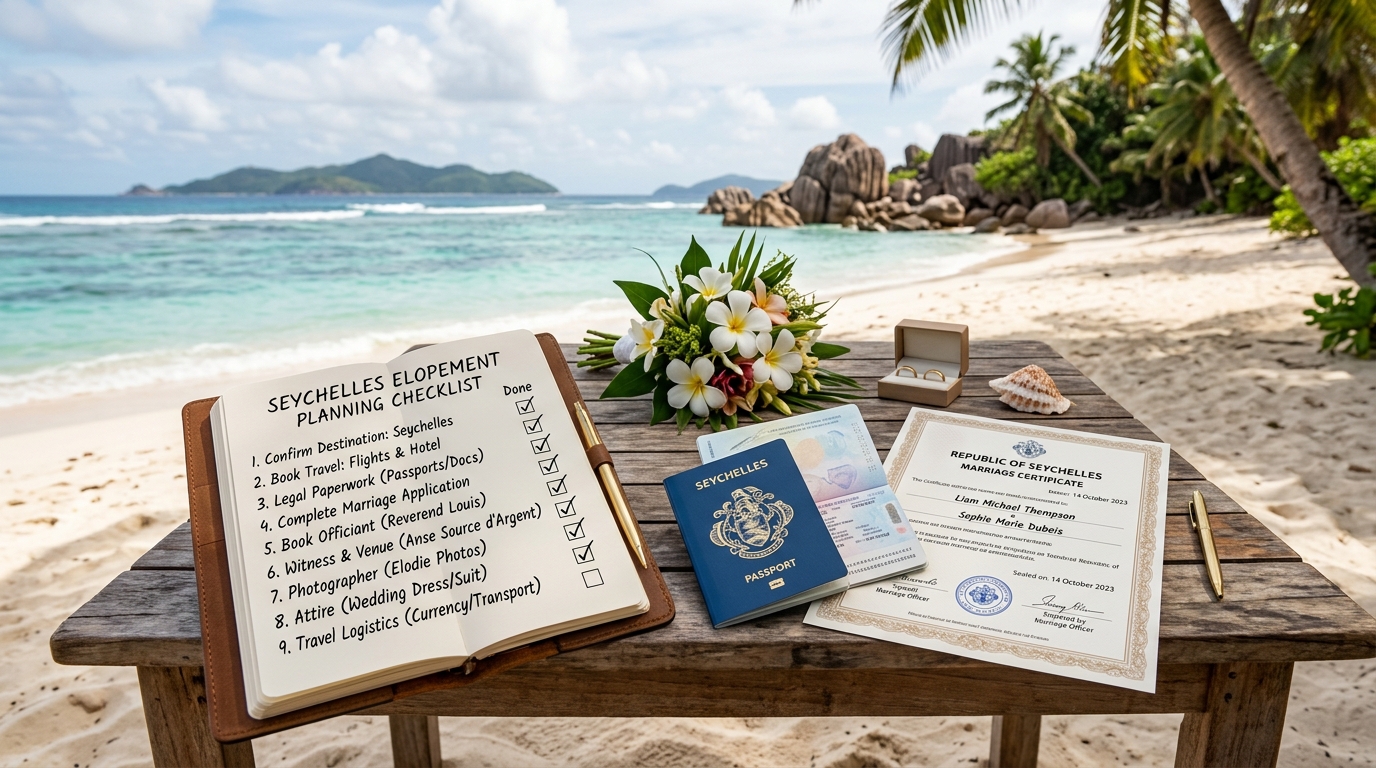
In the US, a beach ceremony permit and a marriage licence are two entirely separate administrative processes that must both be completed correctly. The permit governs your right to use the beach for a ceremony. The marriage licence governs the legal validity of the marriage itself. In Florida, marriage licences are issued at the county clerk's office — $86 in most counties — and require both parties to appear in person. There's a three-day waiting period unless you complete a premarital course. In California, a public marriage licence costs $35–$100 depending on county, and the ceremony must be performed by a licensed officiant. Getting a licensed officiant to a remote beach on a specific date, at a specific time, coordinated with your permit window, is not as straightforward as the county clerk's FAQ implies.
Local Hack: In the Seychelles, the Civil Status Office in Victoria handles all foreign marriage applications. The key detail most couples miss: you need to submit your documents — birth certificates, proof of single status, passports — at least 11 working days before the ceremony date. The registrar who actually processes foreign applications efficiently is not always the one who answers the main line. Weddingsey's ground team knows exactly who to contact and how to track the application status. That knowledge alone has saved at least a dozen ceremonies I'm aware of from last-minute legal complications.
Seychelles marriage law is governed by the Civil Status Act and recognises marriages between foreign nationals provided the documentation is complete and submitted on time. The certificate issued is internationally recognised. The process, managed correctly, is faster and more reliable than navigating three separate US county departments simultaneously.
Beach Elopement Costs: Local Beaches vs Seychelles
The cost comparison between a domestic beach elopement and a Seychelles destination beach elopement is not what most couples expect when they first run the numbers. The domestic option looks cheaper on a spreadsheet until you add every line item honestly. The Seychelles option looks expensive until you realise what's included and what you're not paying for separately.
A DIY beach elopement in Florida or California, done properly — licensed officiant, professional photographer for four hours, permit fees, florals, hair and makeup, a decent dinner reservation — will run $3,500–$6,500 in most coastal markets. That's before flights and accommodation if you're travelling to the destination. And it assumes everything goes smoothly, which, in my experience, it rarely does without a coordinator.
A fully managed beach elopement package in the Seychelles through Weddingsey — covering ceremony coordination, legal processing, officiant, florals, photography, and inter-island logistics — sits in a comparable or only moderately higher range when you account for what's actually included. The flight cost is real. But you're also getting a honeymoon destination built into the same trip.
Hidden Costs of DIY vs Weddingsey All-Inclusive
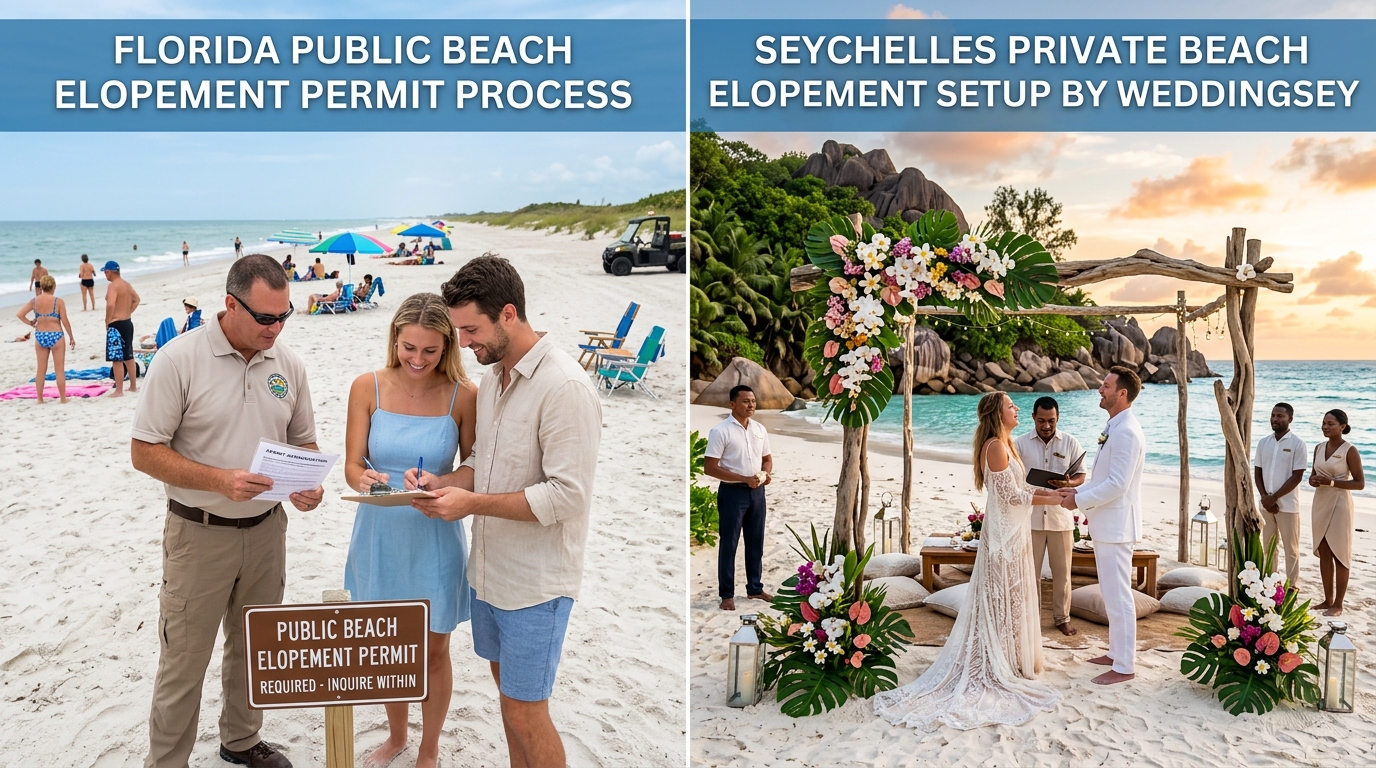
The hidden costs of a DIY beach elopement are the ones nobody lists in the "budget breakdown" blog posts. Vendor cancellation fees when a photographer double-books. Permit re-filing fees when your original date falls during a municipal event. The cost of a second florist when the first one delivers the wrong flowers three hours before the ceremony — which happened to a couple I was brought in to rescue in Fort Lauderdale in 2019. I spent 40 minutes on the phone sourcing replacement arrangements from a wholesale supplier while the couple sat in their hotel room not knowing any of it was happening. That's what ground-level coordination actually looks like.
Honest Warning: Couples frequently target June for a Seychelles beach elopement because the calendar says "summer" and the photographs from that month look spectacular online. But June sits squarely in the Southeast Trades season. On the west coast of Mahé and La Digue, conditions are actually manageable — but if you've set your heart on Anse Intendance on the south coast of Mahé, June is genuinely difficult. The swell is significant, the wind is consistent, and the beach access path can be affected by erosion. I've redirected three June ceremonies away from south-coast venues after couples had already announced the location to their families. Book April or October. The light is better anyway.
Weddingsey's all-inclusive beach elopement packages absorb all of this operational risk. The vendor relationships are established, the legal process is managed end-to-end, and there's a local coordinator who knows which ferry to book and when the tide turns at Anse Source d'Argent.
How to Plan a Beach Elopement Step by Step
If you're planning a beach elopement without professional support, the honest step-by-step process is longer than most guides admit. And if you're planning a destination beach elopement in the Seychelles specifically, the inter-island logistics add a layer of complexity that requires local knowledge you simply cannot Google your way through.
Here's what the actual planning sequence looks like, in order of dependency:
First, confirm legal eligibility in your destination country. Before you book flights, before you choose a beach, before you contact a photographer — confirm that your documents are in order and that the destination's civil registry will process a foreign marriage application in your timeline. This step alone eliminates half the "spontaneous elopement" fantasies I see on planning forums.
Second, choose your island and beach based on season, not aesthetics. I cannot overstate this. The beach that looks perfect in the photograph was photographed in a specific month, in a specific wind direction, at a specific time of day. Ask when the photograph was taken before you commit to the location.
Third, book your accommodation before your ceremony date. On La Digue, accommodation is limited. If you're planning a ceremony at Anse Source d'Argent and you haven't secured a room within walking distance, you're adding a ferry crossing to your ceremony-day logistics. That's manageable — but it needs to be planned, not assumed.
DIY Planning Checklist vs Weddingsey Managed Service
The DIY checklist for a Seychelles beach elopement includes: document apostille and translation (if required), Civil Status Office submission at least 11 working days before the ceremony, Cat Cocos ferry booking for inter-island transport (book at least 4 weeks ahead during peak season — the ferry sells out), accommodation on your chosen island, officiant confirmation, photographer with experience shooting in high-contrast Indian Ocean light, florals sourced locally on Mahé with transport coordinated to your island, and a contingency plan for weather or ferry delays.
That's not a short list. And every item on it has a failure mode.
Weddingsey's managed service handles every one of those dependencies as a single coordinated operation. The legal submission is tracked. The ferry is booked. The florist — and I know which florists on Mahé actually deliver what they promise — is confirmed. The photographer knows the specific granite formations at Anse Source d'Argent and has shot there in every light condition. You arrive. You get married. You don't spend your elopement morning refreshing a ferry booking website.
Comparison: Weddingsey's La Digue ceremony setup is more logistically complex than a Hilton Labriz ceremony on Silhouette Island — the resort handles its own internal logistics — but the result is more private, more photographically distinctive, and not dependent on a resort's event calendar. The sand at Anse Source d'Argent is coarser than the powdery white of Silhouette's north beach, but the granite backdrop is incomparable.
Beach Elopement Styling, Attire, and Photography
Styling a beach elopement requires different thinking than styling a traditional indoor ceremony. The environment is the primary visual element — your job is to complement it, not compete with it. On a beach with 650-million-year-old granite boulders and ink-dark Indian Ocean water behind you, a heavily structured ballgown reads as wrong. Not because it's ugly, but because it fights the geography.
For Seychelles ceremonies specifically, I consistently recommend lightweight fabrics — silk charmeuse, chiffon, or linen — in neutral or warm tones that work with the granite and sand palette rather than against it. Ivory, champagne, and warm white all photograph better against the pink-grey granite than stark white, which bleaches out in direct Indian Ocean sun. For partners who aren't wearing a dress, linen trousers and an open-collar shirt in a natural tone is not a compromise — it's the right call for the environment and the temperature.
Footwear: barefoot or simple sandals. This is not a style suggestion. Sand and heels are a logistical problem, and the path to Anse Source d'Argent involves uneven granite surfaces that will destroy a heel and an ankle simultaneously.
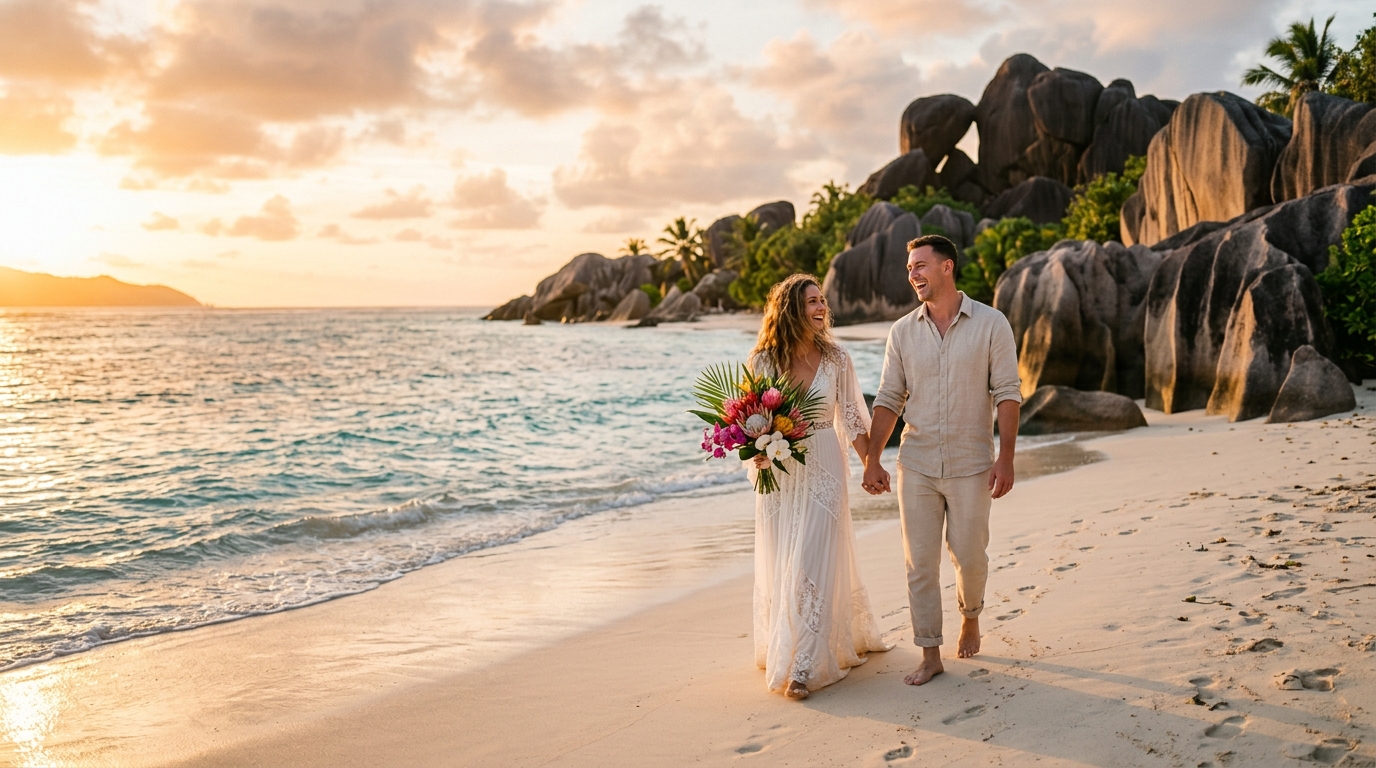
Seychelles Light and Scenery vs Domestic Beach Backdrops
Photography is where the Seychelles advantage becomes impossible to argue with. The combination of equatorial light, granite rock formations, and cobalt Indian Ocean water creates a backdrop that no domestic US beach — not Malibu, not Cannon Beach, not the Emerald Coast — can replicate. The light at Anse Source d'Argent at 17:30 during April or October is warm, directional, and wraps around the granite in a way that creates natural fill light on subjects standing in front of the boulders. Photographers who know the location don't need reflectors. The rocks do the work.
El Matador Beach in Malibu is beautiful and photographs well — the sea stacks are genuinely dramatic — but the light is harsher, the background is more cluttered with other visitors, and the colour palette is cooler and bluer. Cannon Beach offers moody, atmospheric shots that work brilliantly for a certain aesthetic, but the Pacific Northwest overcast means you're often working with flat light and a grey horizon.
For an elopement on the beach where the photographs are part of the point — and for most couples, they are — the Seychelles delivers a photographic environment that requires less post-processing, less equipment, and less luck than any comparable destination I've worked in. Bring a photographer who has shot there before. The ones who haven't tend to underexpose the granite and blow out the sky simultaneously.
When to Elope on a Beach: Seasons and Timing
Timing a beach elopement is not about picking a month that sounds romantic. It's about understanding the meteorological and tidal conditions of your specific beach on your specific date, and building your ceremony window around the data rather than the calendar. This is the part of planning that most couples outsource to optimism. It doesn't work.
In the US, the seasonal calculus varies dramatically by coast. Florida's Gulf Coast peaks between October and April — the summer months bring heat, humidity, and afternoon thunderstorms that can end a ceremony in 90 seconds. California's Malibu is theoretically year-round but June through August brings morning marine layer that doesn't clear until 11:00 or later, which means your golden-hour ceremony is competing with a grey sky until mid-morning. Cannon Beach is genuinely beautiful from June through September, but that's also peak tourist season — the beach is crowded and the accommodation is priced accordingly.
The Seychelles operates on a two-monsoon calendar that most couples don't fully understand until I explain it to them in person.
Seychelles Year-Round Climate vs Seasonal US Beaches
The Seychelles has two dominant seasons: the Northwest Monsoon (November through March), which brings calmer seas, lighter winds, and warmer temperatures; and the Southeast Trades (May through September), which bring consistent southeasterly winds, choppier conditions on exposed coasts, and occasional heavy rain. April and October are the inter-monsoon transition months — lower wind, calmer seas on most coasts, and the best overall conditions for a beach ceremony on almost any island.
The sun drops behind the granite at Anse Source d'Argent at approximately 18:12 during April, giving you a ceremony window from 16:30 to 17:45 for optimal directional light without the harsh midday contrast. That's a specific window, and it matters. A ceremony starting at 15:00 in April will fight flat overhead light for the first hour. A ceremony starting at 17:00 will catch the last 72 minutes of the best light the Indian Ocean produces.
Compare that to Fort Lauderdale in February — the most popular domestic elopement month on Florida's east coast — where the light is good but the beach is shared, the wind is variable, and the permit window may not align with the tidal schedule. You can make it work. But you're managing more variables with less certainty.
If you're serious about a beach elopement that delivers both a legal marriage and photographs you'll actually want to display, April in the Seychelles is the answer. October is a close second. Everything else is a compromise.
Making the Decision: Domestic Beach or Seychelles
Domestic beach elopements are accessible, legally straightforward in most US states, and perfectly valid choices for couples who want simplicity and proximity. Fort Lauderdale, Malibu, and the Emerald Coast all offer real beauty and manageable logistics if you're willing to do the permit work, coordinate your vendors independently, and accept that your ceremony will likely share a beach with strangers.
But if you're reading a guide like this, you're probably not looking for "manageable." You're looking for the version of a beach elopement that actually delivers on what the format promises: genuine privacy, a location that couldn't be anywhere else, a legal marriage that's processed correctly, and photographs that don't look like they were taken at a public park.
The Seychelles — specifically La Digue's Anse Source d'Argent, managed through Weddingsey's end-to-end beach elopement packages — delivers all of that with a level of logistical certainty that DIY planning, on any beach, in any country, simply cannot match. The inter-island logistics are real. The flight is long. The planning timeline is non-negotiable.
And none of that changes the fundamental truth: when you're standing barefoot on pink granite sand with cobalt Indian Ocean water behind you and a marriage certificate in your hand, the 11-hour flight feels like the easiest part of the whole process.
Frequently Asked Questions
What are the best beaches in the world for elopements?
The honest answer depends entirely on what you're optimising for. If you want photographic uniqueness and genuine privacy, Anse Source d'Argent on La Digue in the Seychelles is the strongest option I've encountered in 14 years of destination wedding planning. The granite formations, cobalt water, and equatorial light create a backdrop that no other beach I've worked on can replicate. If you want accessibility and lower cost, El Matador Beach in Malibu and Cannon Beach in Oregon are the strongest domestic US options — both have distinctive scenery and manageable permit processes. Emerald Coast Florida works well for couples who want calm water and warm weather without long-haul travel. But for a destination beach elopement where the location itself is part of the point, the Seychelles is in a different category. The key is matching the beach to your season — and understanding that the "best" beach in June is not the same as the "best" beach in October.
How much does a beach elopement cost compared to the Seychelles?
A properly executed DIY beach elopement in the US — covering a licensed officiant, professional photographer for four hours, permit fees, basic florals, and hair and makeup — runs $3,500–$6,500 in most coastal markets. That's before flights and accommodation if you're travelling to the destination. A Seychelles beach elopement package through Weddingsey, covering ceremony coordination, legal processing, officiant, florals, photography, and inter-island logistics, sits in a comparable range when you account for the full scope of what's included. The flight cost — typically $1,200–$2,500 per person from major US hubs — is the real additional line item. But you're combining your elopement and honeymoon into a single trip, which changes the cost calculation significantly. The hidden costs of DIY — vendor cancellations, permit re-filings, last-minute replacements — don't appear in managed package pricing because they've been absorbed into the operational model.
Do you need a permit to get married on a beach?
In the US, yes — almost universally. A beach ceremony permit and a marriage licence are two separate administrative requirements that must both be completed correctly. Permit costs range from $50 in some Florida counties to $250 or more in California coastal jurisdictions, and most require 2–6 weeks advance filing. Some beaches — particularly in national parks or state reserves — prohibit commercial ceremonies entirely, which means a photographer who charges for their services technically requires a separate vendor permit. In the Seychelles, the permit structure is different. The beaches are legally public, and the ceremony itself is governed by the Civil Status Act rather than a separate venue permit system. What you do need is a correctly filed marriage application submitted to the Civil Status Office in Victoria at least 11 working days before your ceremony date, with all supporting documents apostilled and translated where required. Weddingsey manages this entire process as part of their beach elopement packages.
What is the best time of year to elope on a beach?
For the Seychelles specifically: April or October, without hesitation. These are the inter-monsoon transition months — wind is low, seas are calm on most coasts, and the light during the late afternoon is the best the Indian Ocean produces all year. The sun hits Anse Source d'Argent's granite boulders at 17:30 in April at an angle that creates natural fill light on subjects — no reflectors required. For US beaches: Florida's Gulf Coast peaks October through April; California's Malibu is best September through November when the marine layer has cleared and the tourist crowds have thinned; Cannon Beach works June through August. Avoid June in the Seychelles if you're set on a south-coast Mahé beach — the Southeast Trades make conditions at venues like Anse Intendance genuinely difficult, and I've redirected multiple ceremonies away from that coastline during that month. The couples who insist on June because "the photos looked amazing" are looking at photographs taken in November.
What should a beach elopement package include?
A properly structured beach elopement package — whether domestic or destination — should cover: legal ceremony coordination including marriage licence or civil registration filing; a licensed or registered officiant; professional photography for a minimum of three hours; basic florals appropriate to the environment; and a named point of contact who is reachable on the day of the ceremony. For a destination beach elopement in the Seychelles, the package should additionally cover: inter-island transport coordination including Cat Cocos ferry booking; Civil Status Office document submission and tracking; local vendor management for florals, hair, and makeup; and a contingency plan for weather or transport delays. Weddingsey's beach elopement packages include all of the above as a managed service, which means the operational risk — vendor cancellations, permit complications, ferry delays — is absorbed by the coordinator rather than left to the couple. That's not a luxury add-on. That's the difference between an elopement and an administrative exercise.
Explore the Full Guide
- Elopement vs Destination Wedding: Which Is Right for You?
- Best Beaches to Elope: 15 Shorelines Worldwide Ranked
- Beach Elopement Checklist: Everything to Pack & Plan
- How to Elope Legally Abroad: Marriage Laws by Country
- Elopement Announcement Ideas: How to Tell Family & Friends
- Elopement Ceremony Script: Vow Templates for Two
- Beach Elopement Photography Packages: What to Look For