Beach Wedding Photography Tips: Golden-Hour Magic
“Master beach wedding photography tips for Seychelles golden-hour shots. Real advice on timing, gear, posing, and ocean backdrop wedding photography.”

4,315 words
~20 min
Comprehensive
Part of our Beach Wedding: The Ultimate Planning Guide for Couples guide.
Beach Wedding Photography Tips: Why the Seychelles Changes Everything
Let me be direct with you: beach wedding photography tips that work in the Maldives or Santorini will get you halfway there in the Seychelles. Halfway. The granite boulder coastlines, the equatorial sun arc, the Southeast Trades that arrive with zero warning and rearrange every carefully placed veil — this is not a standard beach environment. I've coordinated over 200 weddings across these islands, and I've watched genuinely talented photographers produce mediocre work because they treated Mahé like Miami.
The Seychelles sits at roughly 4° south of the equator. That matters enormously for anyone thinking about golden hour beach wedding timing, because the sun doesn't linger the way it does in Mediterranean latitudes. It drops. Fast. You have a usable golden-hour window of approximately 35 to 40 minutes on a clear western-coast evening — and on the East coast during the Southeast Trades, you may get none at all, because the cloud bank rolls in from the Indian Ocean by 17:00 and kills the light entirely.
But when it works — when you're on the right beach, on the right coast, in the right month, with a photographer who has actually scouted the location — the ocean backdrop wedding shots you get here are unlike anything produced anywhere else. The cobalt water against pale granite. The casuarina trees bending at exactly the angle that frames a couple without you asking them to move. The light turning the feldspar in the boulders to something close to gold at 18:05.
I work with Weddingsey to coordinate photographer logistics for destination weddings across the archipelago — inter-island transfers, equipment permits, vendor timing — and the couples who arrive with a serious photography plan always leave with better images than those who "trust the moment." The moment is beautiful. The moment is also 38 minutes long and it will not wait for you.
Beach Wedding Photography Tips: Timing Golden Hour vs Seychelles Seasonal Light
Timing is the single most important beach wedding photography tip I can give anyone shooting in the Seychelles. Not lens choice. Not posing. Timing. And timing here is not a creative decision — it's a logistical one, governed by season, coast orientation, and trade wind patterns that most photographers don't bother to research before they land.
The Seychelles operates on two dominant seasons: the Northwest Monsoon (November through March) and the Southeast Trades (May through October), with brief inter-monsoon windows in April and October that are, frankly, the best conditions for photography. During the Northwest Monsoon, the western coasts — Beau Vallon on Mahé, Anse Volbert on Praslin — are calm and clear in the afternoons. During the Southeast Trades, those same beaches get choppy, hazy, and occasionally overcast by late afternoon. You flip to the East coast in theory, but the East coast faces away from sunset. That's your problem.
HONEST WARNING: I have couples ask me every year about June weddings on the South coast of Mahé. Every year. June is peak Southeast Trades season. The wind at Anse Intendance in June can hit 35 knots by 16:00. Your photographer's reflectors become kites. Your bride's dress becomes a structural engineering problem. The light, when it isn't obscured by cloud, is harsh and directional in the worst possible way. I don't book South coast ceremonies in June. I redirect couples to Praslin's West coast or to La Digue's Anse Source d'Argent — which faces southwest and holds calmer air during the Trades because of the island's interior topography.
Best Time of Day for Sunset Wedding Photos
For sunset wedding photos in the Seychelles, your golden window on a western-facing beach runs from approximately 17:45 to 18:20, depending on the month. In April, sunset is around 18:18. In July, it's closer to 18:05. The difference sounds trivial. It isn't — because the angle of descent changes the quality of the backlight dramatically, and a photographer who has only scouted the location at 14:00 will be caught off guard by where the shadows fall at 17:50.
I recommend scheduling the ceremony to end no later than 17:15, which gives you a 30-minute buffer for family formals in the softer pre-golden light, before moving the couple into position for the actual golden-hour beach wedding portraits. Don't try to do everything at once. The family shots in full golden light are always a disaster — someone is squinting, someone is backlit incorrectly, and you've burned 12 minutes of your best light on a group photo that could have been taken at 16:30.
How Seychelles Sun Angles Differ from Tropical Norms
At 4° south latitude, the Seychelles sun tracks almost directly overhead at solar noon — meaning midday contrast is brutal, shadows are near-vertical, and there is almost no flattering natural light between 10:00 and 15:30. Compare this to Bali, which sits at 8° south and gets a slightly more forgiving midday angle, or the Maldives at 3° north, where the sun arc is similar but the flat atoll landscape eliminates the shadow-casting problem that Seychelles granite creates.
The granite boulders — which are the defining visual feature of beaches like Anse Source d'Argent and Anse Lazio — act as massive reflectors. At golden hour, this is extraordinary: the boulders catch the warm light and bounce it back onto the couple from a low angle, effectively giving you a natural fill source that no reflector can replicate. But at midday, those same boulders create deep, irregular shadows that are nearly impossible to expose for correctly without supplemental lighting. Know this before you arrive.
Choosing Beach Locations: Seychelles vs Other Shores
I've scouted beaches in the Maldives, Mauritius, Sri Lanka, and the Greek islands. None of them give you what the Seychelles gives you — and I say that not as a marketing line but as a logistical assessment. The Maldives gives you flat, featureless sandbar shots with ink-blue water and nothing else. Beautiful, yes. Compositionally repetitive after the third frame. Mauritius has decent beaches but the coastline is largely developed, and the light quality suffers from industrial haze on the western shore. Santorini gives you architecture and drama but no beach to speak of.
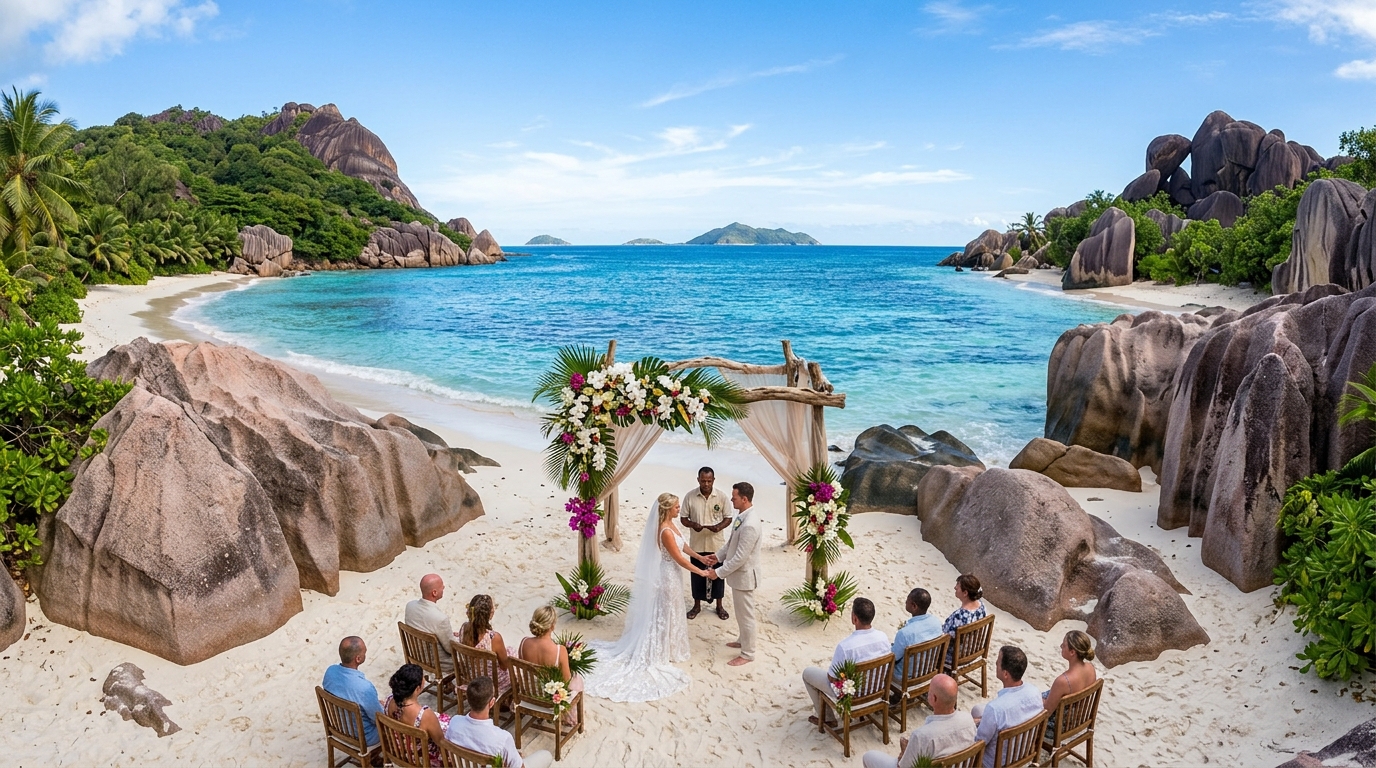
The Seychelles offers something genuinely different: geological texture. The Precambrian granite formations at Anse Source d'Argent on La Digue — which is strategically private in a way Anse Lazio on Praslin is not, simply because La Digue has no airport and limits daily visitor numbers — give photographers vertical and horizontal compositional anchors that no other beach destination provides. You can shoot wide and get rock, water, sky, and couple in a single frame without it looking cluttered. That's rare.
COMPARISON: Anse Source d'Argent is more photogenic than Anse Lazio for wedding portraits — but Anse Lazio has superior sand quality and calmer water for ceremony setups. If I'm choosing purely for photography, I go to La Digue. If the couple wants to wade into the water for shots, Anse Lazio on Praslin is the call. They are not interchangeable, and any photographer who treats them as such hasn't been to both.
What Makes Seychelles Beaches Uniquely Photogenic
The granite. Everything comes back to the granite. These are some of the oldest exposed rock formations on Earth — approximately 750 million years old — and they photograph unlike volcanic rock, unlike coral limestone, unlike anything you'll find in the Caribbean or Southeast Asia. The surface texture catches directional light and holds it. At 17:55 on a clear April evening at Anse Source d'Argent, the boulders go warm amber and the cobalt water behind them shifts toward mercury in the shadow zones. That contrast — warm foreground, cool background — is something photographers spend thousands on lighting equipment to recreate in studios.
LOCAL HACK: La Digue's Anse Source d'Argent sits inside the L'Union Estate reserve. Entry is 115 SCR per person. For wedding photography access during non-public hours — specifically before 09:00 or after 16:30 — you need a separate arrangement with the estate management, coordinated at least 3 weeks in advance. Don't assume your hotel can sort this the day before. I've had to make that call at 07:00 on a shoot morning. It is not a pleasant call to make.
Lens and Gear Choices for Ocean Backdrop Wedding Shots
Ask ten photographers what lens they'd use for ocean backdrop wedding shots and you'll get ten different answers, most of them based on personal preference rather than the specific environment. In the Seychelles, the environment dictates the lens. Not your aesthetic. Not your portfolio style.
The granite formations require you to think in layers — foreground rock, midground couple, background water and sky. A 35mm or 24mm gives you all three layers in a single frame without distortion that makes the boulders look cartoonish. A 50mm prime is my personal preference for couples portraits against the rock faces — it's flattering, it compresses the background just enough to make the cobalt water pop, and it handles the transition between shadow and highlight better than a zoom at equivalent focal length. I don't use 85mm or longer for wide environmental shots here. The compression flattens the geological texture that makes these locations worth shooting.
For ceremony coverage, a 70-200mm f/2.8 is non-negotiable. You need reach, you need speed, and you need the ability to shoot across a beach without walking into the frame. But carry it in a sealed bag between shots. The salt air in the Seychelles is aggressive — more so than in the Mediterranean, in my experience, because the Indian Ocean wind carries a higher particulate load during the Trades.
Wide vs Prime Lens for Beach Wedding Scenes
The wide lens versus prime debate for beach wedding photography tips comes down to one question: what is the dominant feature of your location? If the answer is "the landscape" — which it is at every Seychelles granite beach — you shoot wide for establishing frames and switch to prime for portraits. Simple. What I see photographers get wrong is using a wide lens for everything, including close couples portraits, which produces barrel distortion that no client wants to see in their face.
At Anse Source d'Argent, I brief photographers to use a 24mm or 35mm for the first 15 minutes of golden hour — capturing the full environment with the couple as part of the landscape — then switch to a 50mm or 85mm for the final 20 minutes when the light is warmest and the portraits become the priority. And shoot tethered if you can. The light changes fast enough that you need to see what you're getting in real time, not discover the exposure drift back in the edit.
Managing Harsh Sunlight and Exposure on the Beach
Midday beach light in the Seychelles is not a creative challenge. It is a problem to be managed. The equatorial sun at 12:00 produces a UV index regularly hitting 11 or above — which means shadows under the chin, blown highlights on white dresses, and a reflectivity off white sand that will fool your meter into underexposing the couple by 1.5 to 2 stops if you're not actively compensating.
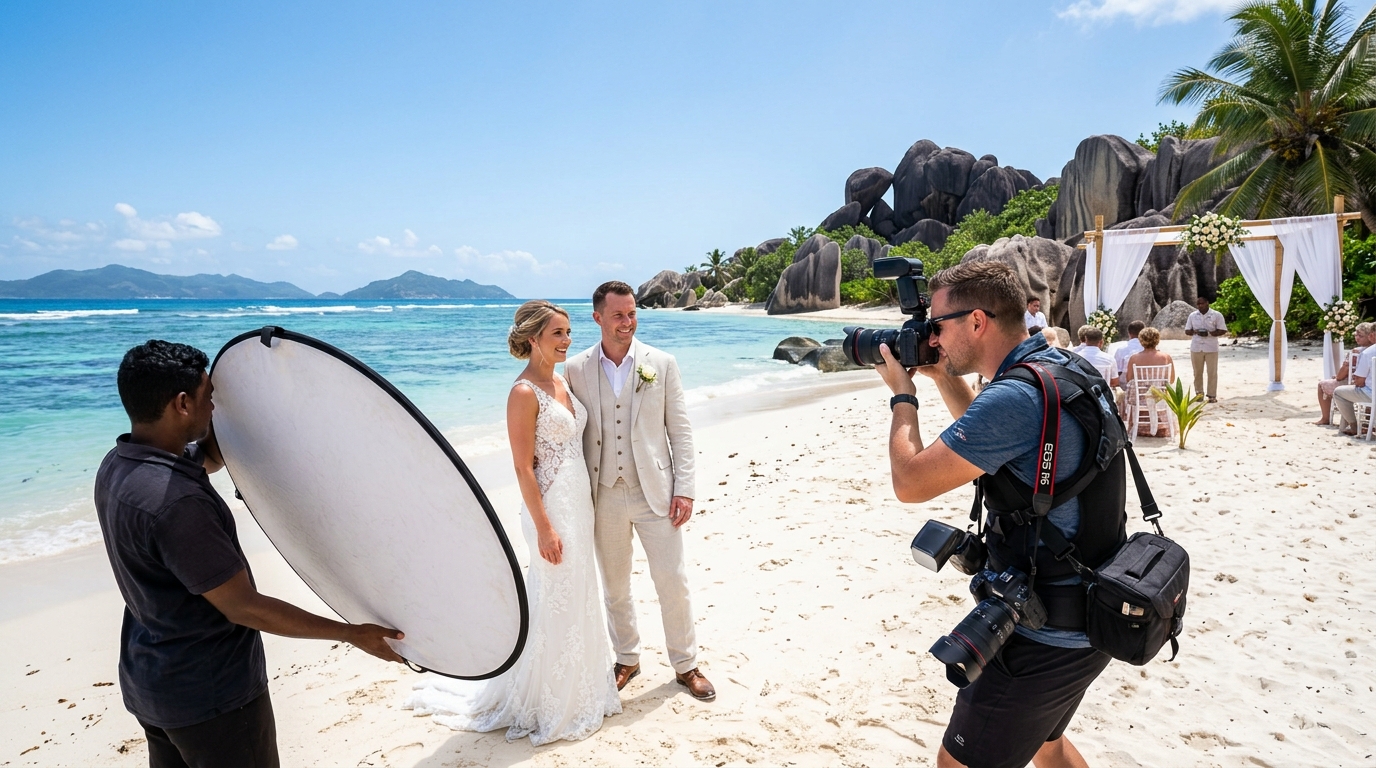
If you're shooting outdoor wedding photography between 10:00 and 15:30 — which sometimes happens when ceremony timing is dictated by tide charts or venue logistics rather than photographic preference — you need a plan. A 5-in-1 reflector used as a diffuser above the couple, held by an assistant, is the minimum. Ideally, you're positioning the couple in the shade of a casuarina tree or a granite overhang, using the open shade as your light source and the bright beach behind them as a luminous background. That's your beach wedding lighting tip for midday: stop fighting the sun and use it as a background element, not a key light.
Exposure compensation of +1 to +1.7 stops is standard for couples against bright sand or water backgrounds. Shoot in RAW. Always. The dynamic range in a Seychelles beach scene — between the deep shadow of a granite crevice and the direct sunlight on white sand — can exceed 12 stops. No JPEG handles that.
Backlighting, Reflectors, and Exposure Compensation Tips
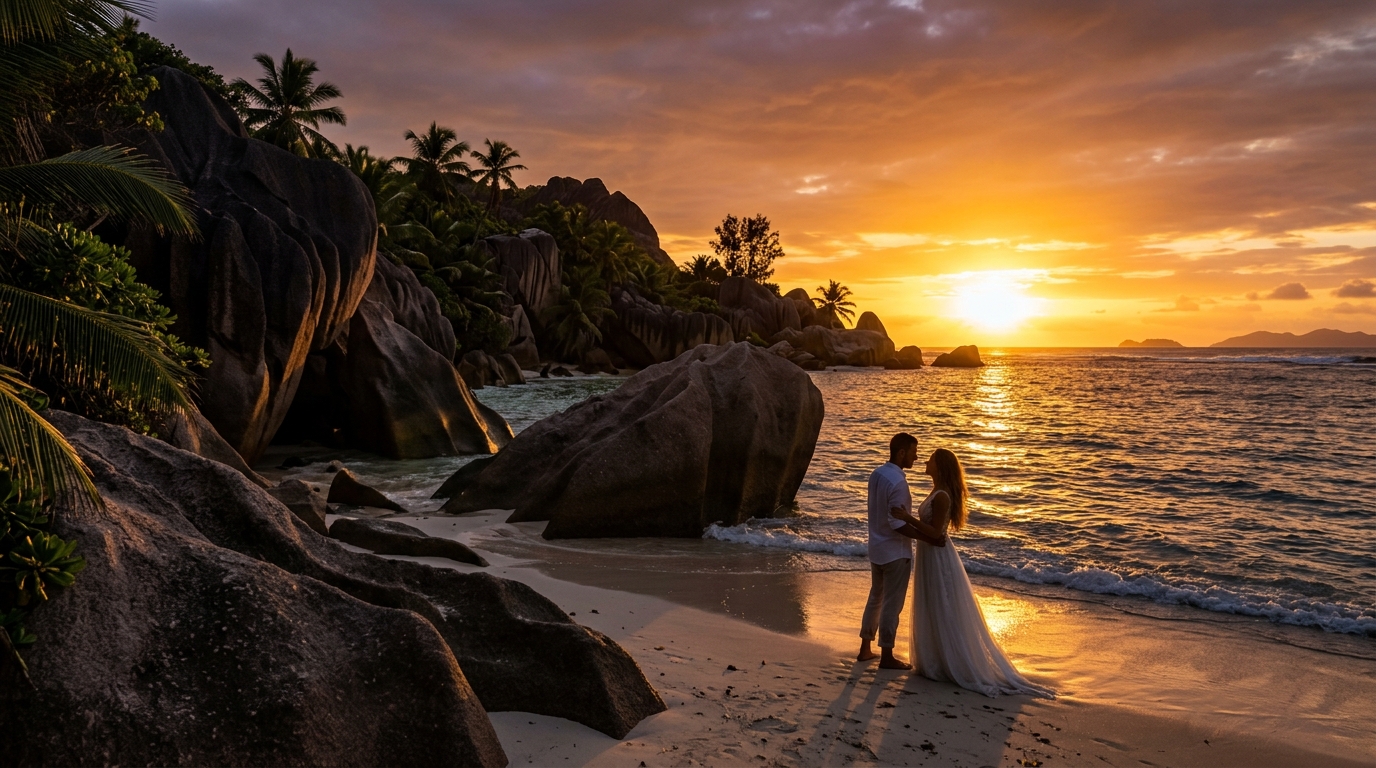
Backlighting is the technique that separates memorable sunset wedding photos from technically correct but emotionally flat ones. In the Seychelles at golden hour, placing the couple between the camera and the setting sun — with the sun dropping behind the granite formations or the horizon line — gives you a rim light that separates them from the background and creates the silhouette effect that clients consistently identify as their favourite image from the day.
For backlighting to work, you need fill. A silver reflector at roughly 45° to the couple's front, positioned low to bounce the ambient ground light upward, fills the shadow side of their faces without introducing a second hard light source. If you don't have an assistant — and on La Digue, where I've seen photographers arrive solo thinking the island's relaxed pace means relaxed logistics — you're using a speedlight at -1.5 stops exposure compensation as your fill. Practice this before you arrive. The Seychelles is not the place to experiment.
Posing Couples Against Seychelles-Style Scenery
If you're directing a couple to "just stand there and look at each other" in front of a 4-metre granite boulder, you've already failed. The scenery in the Seychelles is so dominant that static poses read as tourist snapshots, not wedding portraits. The couple needs to be in relationship with the environment — leaning against the rock, walking through the shallows, moving through the casuarina grove — or the location overwhelms them visually.
I brief every photographer I work with through Weddingsey on this point before they arrive: the Seychelles rewards movement. A couple walking away from camera along the tide line at Anse Lazio, shot at 35mm with the granite headland in the background and the late afternoon light side-lighting the scene, produces a frame that no amount of formal posing achieves. And the couple is more comfortable. Stiff posing in 30°C heat produces stiff expressions. Movement produces genuine reactions.
That said — and I want to be clear about this — "movement" does not mean "run on the beach and laugh." That particular beach wedding photo idea has been done to exhaustion. I'm talking about purposeful, directed movement: the groom adjusting the bride's hair while she looks out to sea, the couple navigating the rocks together with the photographer shooting from above, the bride alone against the boulder face while the groom watches from 10 metres away. Separation and reunion shots in this landscape are extraordinarily powerful.
Natural Posing Techniques for Outdoor Beach Portraits
Natural posing on a beach is a misnomer. Nothing about standing on sand in formal clothing while someone points a camera at you is natural. What you're actually doing is creating the conditions for genuine reaction — and in the Seychelles, the environment does most of that work if you let it.
Give the couple a task. Ask them to find the best view from the top of a boulder and lead each other there. Ask them to walk into the water to a specific depth — knee-height — and react to the temperature. Ask the bride to hold her dress against the wind while the groom steadies her. These are not poses. These are physical situations that produce authentic body language and expression, and they work specifically because the Seychelles environment creates genuine physical challenges: uneven rock surfaces, warm shallow water, wind that actually moves fabric and hair in ways that no fan machine replicates.
Shot Lists and Must-Have Beach Wedding Photos
Every beach wedding needs a shot list. Not because creativity requires a checklist, but because golden hour beach wedding shoots have a hard stop — the light goes, and it doesn't come back. A shot list is a time management tool, not a creative constraint. If you're working with 35 minutes of usable light, you need to know in advance which 8 to 10 frames you're prioritising, so you're not standing on the beach at 18:10 trying to remember whether you got the wide establishing shot.
My standard Seychelles shot list for golden hour: wide environmental with couple small in frame (granite + water + sky), medium couple portrait backlit against sunset, close detail — rings, hands, face — in golden light, silhouette against horizon, couple in water (if tide permits; check the chart — high tide at Anse Source d'Argent eliminates the foreground sand entirely), movement shot walking away, and one frame with the photographer's own creative instinct that isn't on the list. That last one is always the one the couple puts on the wall.
LOGISTICAL SAVE: I once had a photographer lose 18 minutes of golden hour because the tide came in faster than anticipated and the primary shooting position at Anse Source d'Argent became ankle-deep water. We hadn't confirmed the tide chart for that specific date — my oversight, not the photographer's. We moved to the secondary position behind the main boulder cluster, shot from elevation, and the images were actually stronger. But I've checked tide charts for every shoot since. Religiously.
Drone and Overhead Shots Unique to Seychelles Terrain
Drone photography in the Seychelles requires a permit from the Civil Aviation Authority — apply at least 14 days before the wedding date, and expect to pay a processing fee. Don't assume your photographer can fly without one. I've had a shoot halted by local authorities on Praslin because the operator assumed resort permission was equivalent to CAA clearance. It is not.
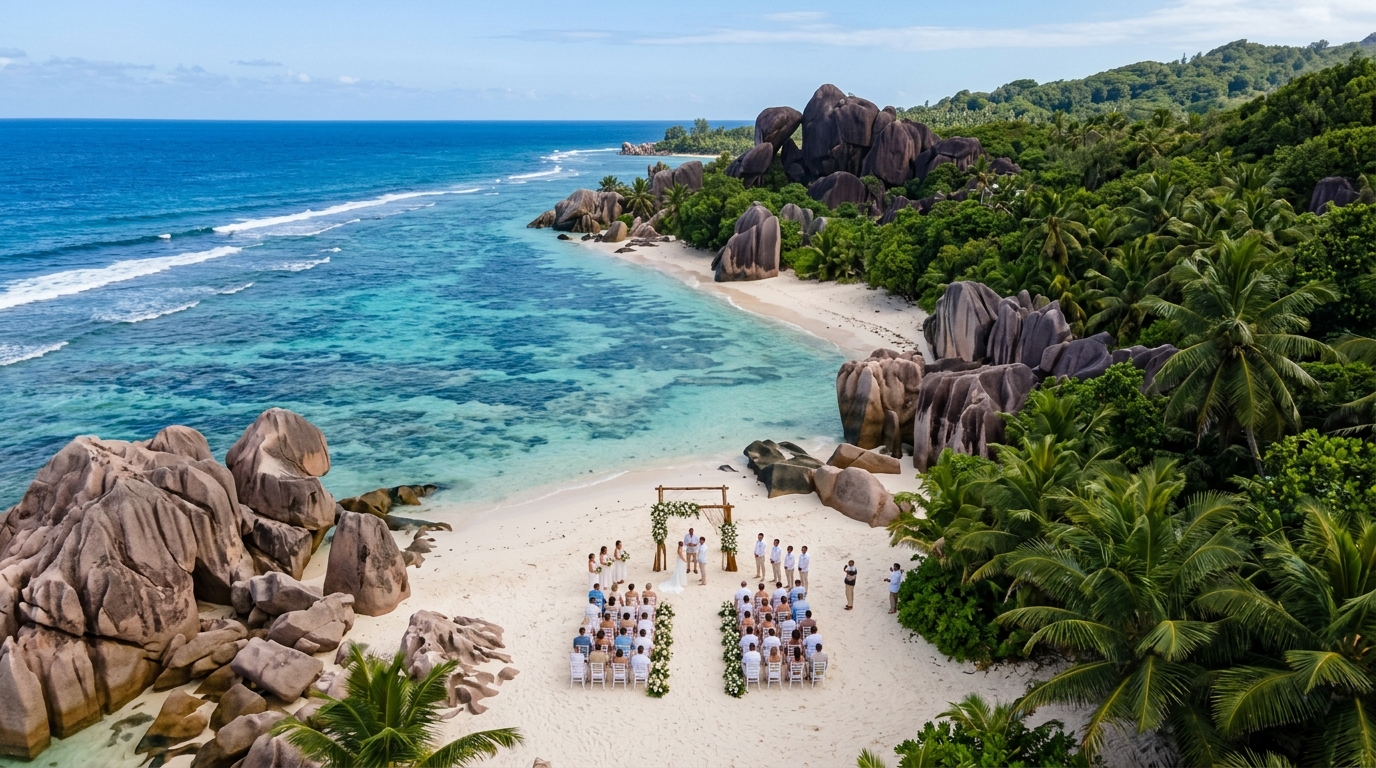
But when you have the permit and the conditions are right — low wind, clear sky, the inter-monsoon shoulder months — aerial shots of the Seychelles coastline are genuinely unmatched. The overhead view of Anse Source d'Argent reveals the full geological structure: the boulder formations, the shallow lagoon shifting from pale jade to deep cobalt, the white sand channels between the rocks. No other beach destination I've worked in produces aerial wedding images with this level of compositional complexity. The Maldives gives you blue and white. The Seychelles gives you texture, colour gradient, and geological drama in a single frame.
Protecting Gear from Sand, Salt, and Seychelles Weather
Salt air destroys camera equipment. This is not a dramatic statement — it is a maintenance fact that photographers who work in coastal environments understand and photographers who don't have never had to replace a corroded aperture mechanism. The Seychelles, particularly during the Southeast Trades, pushes salt-laden air inland with enough force to deposit residue on lens elements within 20 minutes of exposure.
My protocol, which I share with every photographer I coordinate through Weddingsey: sealed pelican cases for transport, lens cloths changed every 30 minutes during outdoor shoots, rear element checked and cleaned between every location change, and a full body wipe-down with a dry microfibre cloth immediately after the beach session — before the equipment goes back into the bag. Sand is the other problem. The fine coral and granite sand at Seychelles beaches gets into everything. A single grain on a sensor costs more to fix than a night in a mid-range hotel on Mahé.
For weather contingency — because the Seychelles can produce a 20-minute rain squall with no warning, even in the dry season — every photographer I work with carries a rain sleeve for each body and a waterproof cover for the bag. Not a plastic bag. A proper cover. Because when a squall hits during a ceremony, you have approximately 45 seconds to protect your equipment and still keep shooting.
Wind and Weather Contingency Planning for Beach Shoots
TIDE AND WIND OBSERVATION: On the western coast of Mahé — specifically Beau Vallon and Anse Major — the Northwest Monsoon season (November through March) delivers calm afternoon conditions ideal for outdoor wedding photography. Wind speeds between 14:00 and 18:00 typically run 8 to 12 knots, which moves fabric attractively without creating chaos. But during the Southeast Trades (May through October), those same beaches see gusts of 20 to 30 knots by mid-afternoon. That's not a photography inconvenience. That's a structural problem for ceremony setups and a practical impossibility for controlled portrait work.
Always have a secondary indoor or sheltered location confirmed before the shoot date. On Mahé, I use the interior of plantation estates — shaded, architecturally interesting, wind-protected — as fallback positions. On La Digue, the L'Union Estate coconut grove works. On Praslin, the Vallée de Mai provides extraordinary filtered light through the coco de mer palms, though it requires a separate entry permit. None of these are compromises. They're different images, and sometimes better ones.
Frequently Asked Questions
What is the best time of day to shoot beach weddings?
In the Seychelles specifically, your optimal window for beach wedding photography is 17:30 to 18:20 on a western-facing beach during the Northwest Monsoon season. That gives you approximately 50 minutes of usable golden and transitional light before the sun drops behind the horizon and the quality degrades rapidly. Outside the Seychelles — in Mauritius, for example, or Bali — you have a slightly longer window because the sun arc is less steep at higher latitudes. But the principle holds everywhere: schedule your ceremony to end at least 60 minutes before sunset, use the pre-golden hour for family formals, and protect the actual golden window for couples portraits. Don't try to do everything in that window. Pick your 8 to 10 priority frames and execute them with precision. The light will not wait for indecision.
What lens should you use for beach wedding photography?
For Seychelles beach weddings specifically, I recommend a 35mm prime for wide environmental shots that incorporate the granite formations, a 50mm prime for couples portraits during golden hour, and a 70-200mm f/2.8 for ceremony coverage from a respectful distance. The 85mm is a fine portrait lens in controlled environments, but in the Seychelles the background compression it produces can flatten the geological texture that makes these locations distinctive. Avoid ultra-wide lenses — 16mm or 14mm — for anything involving the couple's faces. The distortion at close range is unflattering and no amount of post-processing corrects it convincingly. If you're shooting in other beach destinations — the Maldives, for instance, where the landscape is flat and featureless — a 24-70mm zoom is a practical all-in-one choice. But in the Seychelles, the environment rewards prime lenses and deliberate focal length choices.
How do you photograph in harsh midday sunlight on the beach?
Stop trying to use the sun as a key light between 10:00 and 15:30 on a Seychelles beach. It won't work. The UV index regularly exceeds 11, the shadows are near-vertical and unflattering, and the reflectivity off white sand will fool your meter consistently. Instead, position the couple in open shade — the shadow side of a granite boulder, under a casuarina grove, beneath a natural overhang — and use the bright beach as your background light source rather than your key. Apply +1 to +1.7 stops of exposure compensation to avoid underexposing the couple against the bright background. Shoot RAW without exception — the dynamic range in a midday beach scene can exceed 12 stops and no JPEG captures it. If you must shoot in direct midday sun, use a 5-in-1 reflector as a diffuser held above the couple by an assistant, and keep sessions short. Heat stress affects posture and expression within 15 minutes.
What are the must-have shots for a beach wedding?
For a Seychelles beach wedding, my non-negotiable shot list covers eight frames: the wide environmental establishing shot with the couple small in the landscape, the backlit silhouette against the sunset horizon, a medium portrait in direct golden light, a close detail frame — rings, hands, or face — in warm late light, a movement shot with the couple walking or interacting naturally, one frame in or near the water if tide conditions allow, an aerial drone overview of the ceremony setup showing the full coastline context, and one frame that was not on the list — the photographer's own instinct responding to something unexpected in the environment. That last frame, in my experience across 14 years and over 200 Seychelles weddings, is consistently the one that ends up printed and framed. Plan for eight. Leave room for nine.
How do you protect camera gear from sand and saltwater?
Salt air deposits on lens elements within 20 minutes of exposure in coastal conditions — faster during the Southeast Trades in the Seychelles when wind-driven salt particulate is measurably higher. My protocol: sealed pelican cases for all transport between locations, lens cloths replaced every 30 minutes during active shooting, rear elements checked and cleaned at every location change, and a full body wipe-down with dry microfibre immediately after each beach session before equipment returns to the bag. For sand — which is a different problem entirely, because a single grain on a sensor creates a repair bill that exceeds a night's accommodation on Mahé — never change lenses on the beach. Move to a sheltered position, ideally a vehicle interior or a covered terrace, for any lens swap. Carry a rocket blower. Use it before every lens change. And carry a proper waterproof bag cover, not a plastic bag — because when a Seychelles squall arrives, you have 45 seconds.